
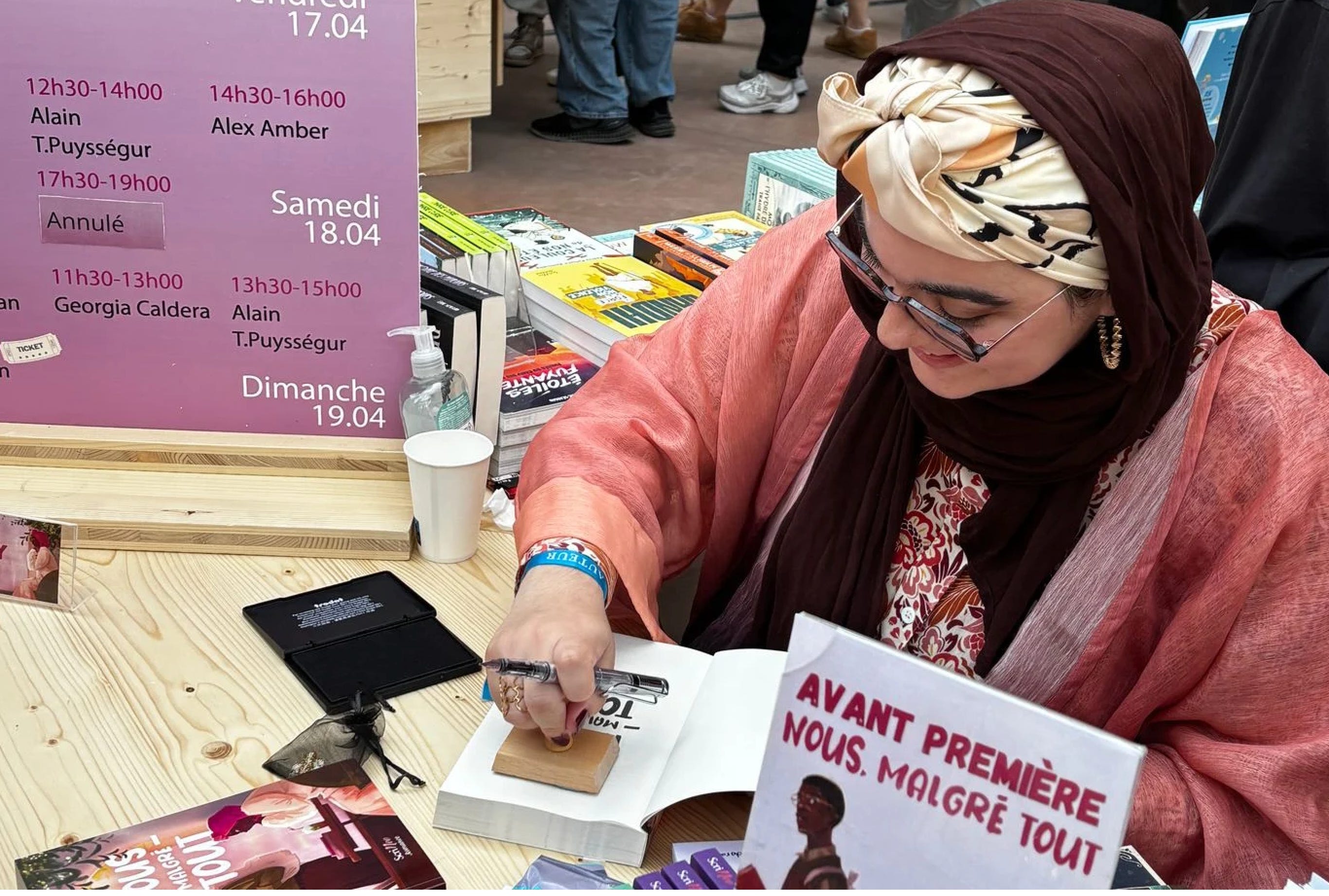
1/ You have drawn attention to the emergence of “halal romance,” presented as inclusive literature but which you describe as “sharia-compatible” literature. Behind an apparently consensual discourse about diversity and modesty, are we, in your view, witnessing the insidious introduction of Islamist norms into cultural production and, now, into our collective imagination?
I am not a whistleblower; I analyse a phenomenon and point to its possible consequences rather than denounce it. As a CNRS researcher, I make sure to provide all the elements so that everyone can form their own opinion. For thirty years, I have been describing the phenomenon of market “halalisation,” which is the most effective method of Islamisation and dissemination of Islamic norms in our consumer societies. I describe the fine-grained mechanisms of what I regard as a jihad: a proselytising struggle to impose an Islamist norm without our being aware of it, and to turn our societies into sharia-compatible societies.
What is happening with “halal romance” follows the same mechanism as the creation of the global halal meat market that emerged in the 1980s. Twenty years ago, I described how this developing market, which at the time mainly concerned food, was driven by an alliance between neoliberalism and neo-fundamentalism—an alliance that would not stop at that sector but would extend to all products and services. The expansion of the scope of halal had already been planned in the 1990s, because the economy is one of the Muslim Brotherhood’s fields of conquest, alongside politics, education and development, which have spread across every continent.
My research was hindered by an academic environment in the social sciences dominated by the radical left, deliberately blind to Islamic proselytism, more commonly known as da’wah or Islamisation, on the grounds that it was supposedly a “fascist” topic. My progress was also impeded by those who had become - and unfortunately remain - entangled in endless discussions about the difference between Islam and Islamism. In my view, this insoluble debate is of absolutely no interest. What must be analysed is Islamisation: the conquest of souls and territories that Salafism—of which Brotherism (frérisme) is a modern variant—presents as an obligation for every Muslim. Finally, I was silenced by those who claimed that this proselytism was comparable to that of the Christian world and that it would disappear as Muslims, supposedly victims of “Islamophobia,” became more prosperous and integrated. Yet the thesis that Islamism originates in poverty, exclusion and racism has been contradicted day after day, at least since the discovery that the well-integrated terrorists of 9/11 were funded by the billionaire Bin Laden.
Despite the obstacles, the fact remains that my analyses were correct. Literature, too, has logically been affected by the process of halalisation/Islamisation.
What is remarkable is that this halal literature, which I call sharia-compatible, does not belong to a separate religious genre, as we have seen with Christian publishing, which is a niche market concerned with moral education. Brotherism (the neologism I use to designate the ideology of the Muslim Brotherhood) does not want a niche market; it seeks to impose the norm it regards as universal in every sector and in everyone’s imagination. This has been embedded in its DNA since 1928. The Muslim is required to impose his norm on others, because he will not be able to live “his Islam” in an integral way, as required, if the surrounding culture, local traditions and law prevent him from doing so. The culture, traditions and laws of the surrounding environment must therefore be Islamised so that Muslims can first live in a sharia-compatible society which, in the long term, they believe will naturally become sharia-compliant.
2/ You draw a parallel with the running hijab marketed by Decathlon and write that “nothing comes to stop the alliance between the market and Islamism.” Is this precisely the strength of the strategy: to normalise ideological or religious markers by turning them into ordinary consumer products, until their political significance becomes almost invisible?
A “running hijab” is an English term for a hijab designed for running and sport in general. The idea is that a Muslim woman will not be able to run unless she is equipped with suitable clothing. This is a way of asserting that one cannot be a Muslim woman without wearing the hijab. Of course, the merchant will never acknowledge the normative—and therefore political—influence of such a product; he will point out that everyone has the “choice” whether or not to buy it.
Halalisation is a two-stage process: first, designate something as prohibited; then offer a permitted (halal) equivalent or substitute. Labelling products or services “haram” (forbidden) creates the basis for developing a halal commercial range. The legalist Islamists represented by the Brotherists have understood perfectly how to sell this and involve merchants, who are always on the lookout for market segmentation that can create new niches.
Once the mechanism is understood, it becomes easier to identify those responsible. Merchants sell things; that is their job. But when they place themselves at the service of a rigorist norm -one whose definition is moreover unstable - they effectively become agents of Islamic proselytism, whether they intend to or not.
They can even become trapped themselves. A non-Muslim company that sells halal products will sooner or later be questioned about its reliability; it will have to provide ever more guarantees of its ability to ensure that the products are religiously permissible. This leads to an escalation that may result in the Islamisation of its staff—for example, by recruiting Muslims rather than non-Muslims. What could be more reassuring to a consumer seeking halal food than seeing it served by a bearded man or a veiled woman? This is what I call the “beard premium.”
3/ In your book Le Djihad par le marché. Comment l’islam radical s’empare du marché halal (Jihad through the Market: How Radical Islam Is Taking Over the Halal Market), you describe the mechanisms through which the market can become a powerful vector for the expansion of Islamic norms. With “halal romance,” are we moving a step further, since it is no longer merely a question of determining what we eat or wear, but also the stories we tell, the representations we disseminate and, ultimately, the collective imagination we help to shape?
With the expansion of halal to encompass all food products and modest fashion, this development towards halal romance was foreseeable, because it was already in the pipeline of the global Islamic economy and Islamic marketing. For at least ten years, the halal media sector has been one of the 7 lifestyle and finance sectors defined in the State of the Global Islamic Economy Report published by DinarStandard[1]. These seven sectors are: halal food, Islamic finance, modest fashion, Muslim-friendly travel, halal pharmaceuticals, halal cosmetics, and media and recreation.
The Islamisation of literature through the market begins with an initial negative stage: excluding, correcting or avoiding what is deemed haram, often in the name of respecting Muslim sensitivities. It then enters a positive phase of production: the aim is no longer merely to remove certain content, but to offer an alternative cultural universe presented as halal, with its own norms, characters, narratives and models of behaviour. This logic spreads by capillary action: from literature to children’s publishing, media, television series and leisure, and then to fashion, tourism, cosmetics, pharmaceuticals and finance. As demand is identified, economic actors create a dedicated supply; that supply, in turn, normalises new practices, broadens the audience and gradually transforms halal into a cross-cutting norm of consumption and representation. Muslims on every continent, wherever they come from, are thus called upon to live within halal, within the Islamic Way of Life. I am borrowing here the title of a work by Mawdudi, the Indo-Pakistani thinker who was, in a sense, one of the originators of this form of social engineering.
4/ Have Western companies and cultural actors not become, in the name of conquering new markets and of a certain conception of diversity, the involuntary—or sometimes even willing—auxiliaries of this enterprise of normalisation? In the face of this advance, how can we prevent commercial logic from contributing to the lasting establishment in society of norms inspired by Islamism?
Once the mechanism and its traps are understood, it is clear that merchants who take part in the halal market by having their products certified or creating new ranges based on Islamic marketing are jointly responsible for disseminating the norm. But are they aware of this? I would say yes, but not to the point of understanding their role and the risks they are taking. These market actors are lulled by a multicultural ideology that is blind to Muslim proselytism and for which the word “Islamisation” is merely an obsession of “racists.” They often enter the halal market with interest and in good faith, wishing to take part in the “happy diversity” of multicultural society. They often deny its religious character by emphasising the cultural dimension, while being attracted by the prospect of profit. There is no mechanism to warn them of what may happen if they invest in the halal market, or of the trap I have described. Neither the Ministry of Agriculture nor the Ministry of Commerce, and certainly not universities, which instead work to optimise Islamic finance and halalised industrial supply chains. Yet halalisation is not only a problem for democratic secularised society and its values, which are not compatible with the Islamic proposition; in the long term, it is also a problem for merchants who enter unfamiliar territory without mastering the content of the norm.
As I have shown, the dynamic of Islamisation is such across all five continents, and particularly in the countries of the Organisation of Islamic Cooperation, that a company entering the halal market and selling to Muslim minorities or Muslim countries will have to provide guarantees if it does not want to be boycotted. We saw this in the case of Isla Délice, whose director had to announce publicly that he would never work with Israel. The pressure exerted by the boycott of Israeli products—like the boycott of Danish products during the Danish cartoons affair, as we may recall—is immense. It is only a glimpse of the economic war that awaits us: jihad through the market.
Dr Florence BERGEAUD-BLACKLER
Research Fellow, French National Centre for Scientific Research (CNRS) President, European Centre for Research and Information on Brotherism (CERIF)
Author of Le Djihad par le Marché (Jihad through the Market), Odile Jacob, 2025
[1] https://www.dinarstandard.com/insights/state-of-the-global-islamic-economy-report-2025-26?utm_source=chatgpt.com